What Is Original Medicare?
What Is Original Medicare?
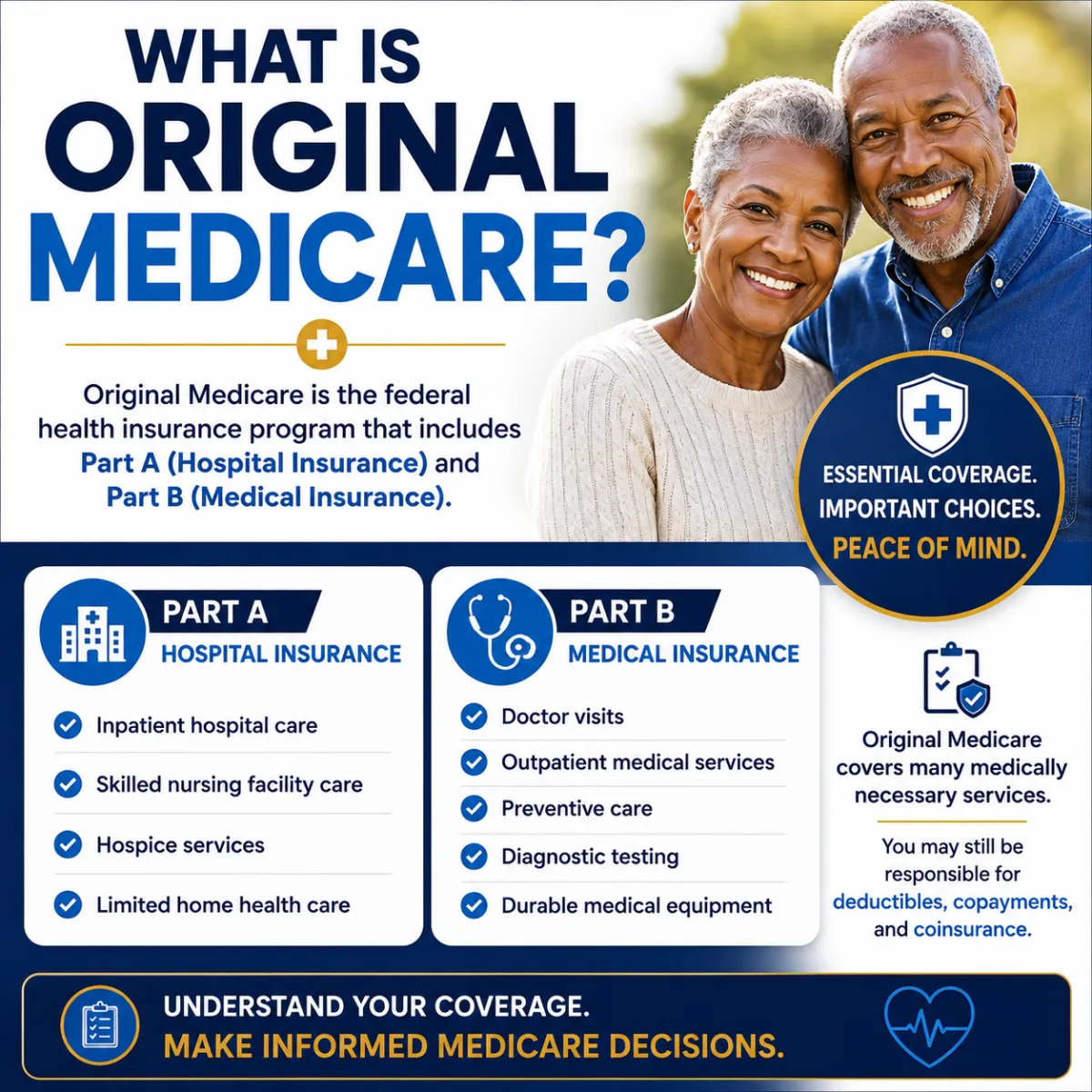
Original Medicare is the federal health insurance program administered by the U.S. government. It provides healthcare coverage primarily for people age 65 and older, as well as certain individuals under age 65 who qualify because of a disability or specific medical condition.
Original Medicare includes two main parts:
Medicare Part A — Hospital Insurance
Medicare Part B — Medical Insurance
Together, Parts A and B help cover many medically necessary hospital, medical, and healthcare services. However, Original Medicare does not pay for every healthcare expense, and beneficiaries may still have out-of-pocket costs.
What Does Medicare Part A Cover?
Medicare Part A is commonly known as hospital insurance. It primarily helps cover care received as an inpatient or through certain facility-based healthcare services.
Inpatient Hospital Care
Part A may help cover medically necessary services when you are formally admitted to a hospital as an inpatient.
Covered services may include:
Semi-private hospital rooms
Meals
Nursing care
Medications provided during an inpatient stay
Other medically necessary hospital services and supplies
Being kept in a hospital for observation does not always mean you have been admitted as an inpatient. Your hospital status can affect how Medicare covers your care and what you may be required to pay.
Skilled Nursing Facility Care
Part A may help cover short-term care in a Medicare-certified skilled nursing facility after a qualifying inpatient hospital stay.
Covered services may include:
Skilled nursing care
Physical therapy
Occupational therapy
Speech-language therapy
Medically necessary supplies and services
Skilled nursing facility coverage is generally intended for rehabilitation and medical care. It does not typically cover long-term custodial care when personal assistance is the only type of care needed.
Hospice Services
Medicare Part A may cover hospice care for people who are terminally ill and meet Medicare’s eligibility requirements.
Hospice services may include:
Medical and nursing care
Pain and symptom management
Prescription medications related to the terminal illness
Medical equipment and supplies
Counseling and social services
Short-term respite care for caregivers
Hospice care focuses on comfort and quality of life rather than treatment intended to cure the terminal illness.
Limited Home Health Care
Part A may help cover certain home health services when Medicare’s requirements are met.
Services may include:
Part-time skilled nursing care
Physical therapy
Occupational therapy
Speech-language therapy
Certain home health aide services provided alongside skilled care
Medicare generally does not cover full-time home care, meal delivery, housekeeping, or personal care when those are the only services needed.
What Does Medicare Part B Cover?
Medicare Part B is commonly known as medical insurance. It helps cover many outpatient healthcare services, physician services, preventive care, testing, and medical equipment.
Doctor Visits
Part B may help cover medically necessary services provided by doctors and other qualified healthcare professionals.
This may include visits with:
Primary care physicians
Specialists
Nurse practitioners
Physician assistants
Other Medicare-approved providers
Outpatient Medical Services
Part B may cover care received without being formally admitted to a hospital.
Examples may include:
Outpatient surgery
Emergency room services
Ambulance services when medically necessary
Mental health services
Certain medications administered in a medical setting
Outpatient therapy services
Preventive Care
Part B covers many preventive services designed to help identify health concerns early.
Covered preventive services may include:
Annual wellness visits
Flu shots
Certain vaccines
Cancer screenings
Diabetes screenings
Cardiovascular screenings
Bone-density testing
Other Medicare-approved preventive services
Some preventive services may be available without cost-sharing when Medicare’s requirements are met and the provider accepts Medicare assignment.
Diagnostic Testing
Part B may help cover medically necessary tests used to diagnose or monitor a medical condition.
Examples include:
Blood tests
X-rays
Magnetic resonance imaging scans
Computed tomography scans
Laboratory services
Other diagnostic procedures
Coverage may depend on whether the test is medically necessary and ordered by a qualified healthcare provider.
Durable Medical Equipment
Part B may cover certain durable medical equipment prescribed for use in the home.
Examples may include:
Walkers
Wheelchairs
Hospital beds
Oxygen equipment
Blood sugar testing equipment
Continuous positive airway pressure machines
The equipment and supplier must meet Medicare’s coverage and participation requirements.
What Original Medicare Does Not Fully Cover
Original Medicare provides broad healthcare coverage, but it does not cover every service or pay 100% of all approved costs.
Depending on the service, beneficiaries may be responsible for:
Premiums
Deductibles
Copayments
Coinsurance
Costs for services Medicare does not cover
Original Medicare also generally does not include routine coverage for:
Most outpatient prescription drugs
Routine dental care
Routine vision exams and eyeglasses
Routine hearing exams and hearing aids
Long-term custodial care
Most healthcare services received outside the United States
Coverage rules and exceptions may apply, so beneficiaries should review their specific healthcare needs carefully.
How Original Medicare Costs Work
Under Original Medicare, beneficiaries may receive healthcare services from doctors, hospitals, and other providers throughout the United States that accept Medicare.
Medicare generally pays its approved share of the cost for covered services. The beneficiary is responsible for the remaining approved amount and any applicable deductible, coinsurance, or copayment.
Original Medicare does not include an annual out-of-pocket maximum. This means there is no built-in yearly limit on the amount a beneficiary may have to pay for covered Part A and Part B services.
Some beneficiaries choose additional coverage to help manage these expenses.
Is Prescription Drug Coverage Included?
Most outpatient prescription drugs are not included in Original Medicare.
Beneficiaries who want prescription drug coverage may enroll in a separate Medicare Part D prescription drug plan. Part D plans are offered by private insurance companies approved by Medicare.
Certain medications administered in a doctor’s office, hospital outpatient department, or medical facility may be covered under Part B.
Can You Add Additional Coverage?
People enrolled in Original Medicare may have options for additional coverage.
These may include:
A Medicare Supplement Insurance policy to help pay certain out-of-pocket costs
A stand-alone Medicare Part D prescription drug plan
Employer or union-sponsored retiree coverage
Medicaid for individuals who meet eligibility requirements
Other qualifying health coverage
Medicare Supplement policies are sold by private insurance companies and are designed to work alongside Original Medicare.
Original Medicare Compared With Medicare Advantage
Original Medicare is not the same as Medicare Advantage.
Original Medicare includes Part A and Part B and is administered by the federal government. Medicare Advantage, also known as Medicare Part C, is an alternative way to receive Medicare benefits through a private insurance company approved by Medicare.
Medicare Advantage plans must provide at least the benefits covered under Parts A and B. Many plans may also include additional benefits or prescription drug coverage, but provider networks, costs, rules, and benefits can vary by plan.
Understanding the differences between these coverage options can help beneficiaries make informed decisions based on their healthcare needs and budget.
Why Understanding Original Medicare Matters
Learning how Original Medicare works can help you:
Understand which healthcare services may be covered
Prepare for potential out-of-pocket expenses
Determine whether additional coverage may be appropriate
Avoid confusion when receiving medical care
Make more informed Medicare decisions
Before enrolling in any Medicare coverage, consider your doctors, medications, preferred hospitals, expected healthcare needs, travel habits, and budget.
Final Thoughts
Original Medicare provides important federal health insurance coverage through Medicare Part A and Medicare Part B.
Part A generally helps cover inpatient hospital care, skilled nursing facility care, hospice services, and limited home health care. Part B generally helps cover doctor visits, outpatient medical services, preventive care, diagnostic testing, and durable medical equipment.
Although Original Medicare covers many medically necessary services, beneficiaries may still be responsible for premiums, deductibles, copayments, and coinsurance. Understanding these costs and coverage limitations is an important part of preparing for Medicare.
Educational Disclaimer: This content is provided for general educational purposes only and is not intended to provide legal, medical, financial, or insurance advice. Medicare rules, costs, benefits, and eligibility requirements may change. Review current Medicare information and your individual circumstances before making healthcare coverage decisions.
Sam Gross Agency Owner
Senior Advantage Marketing Group
To speak with a licensed insurance agent, click here >>>>>set appointment
